Stephen Alatriste · Creative engineer
A little less ordinary.
Querywright
03 / Featured work
Querywright
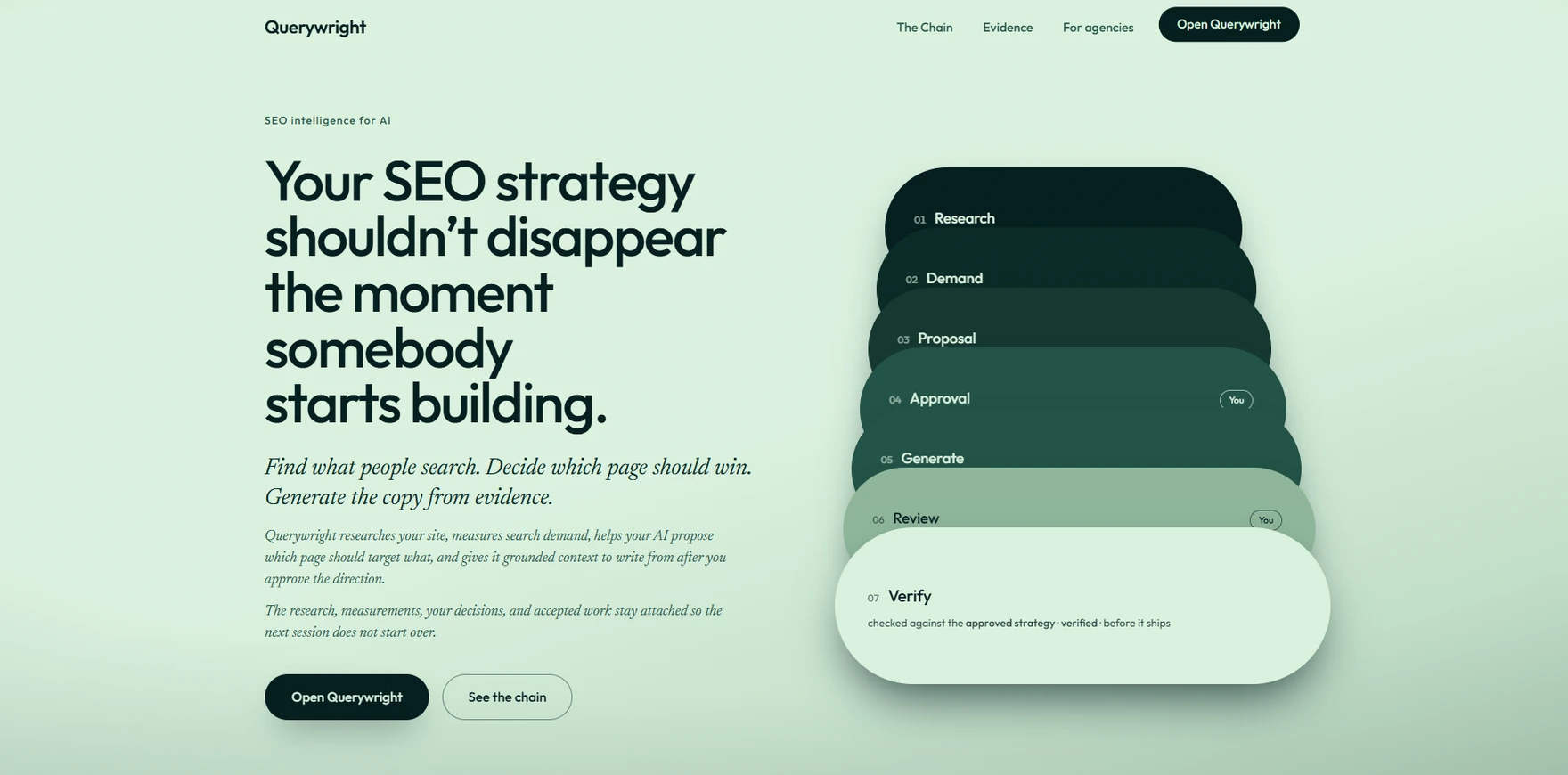
Founder and sole developer. The app, its MCP server, the marketing site and the layered green system it wears, designed and built solo.
Seven steps, from Research to Verify. The fourth and the sixth belong to a person, so a recommendation can never quietly become a decision.
I’m Stephen. I turn curious ideas into websites, useful tools, and interactive things you don’t quite want to close.
Step inside my work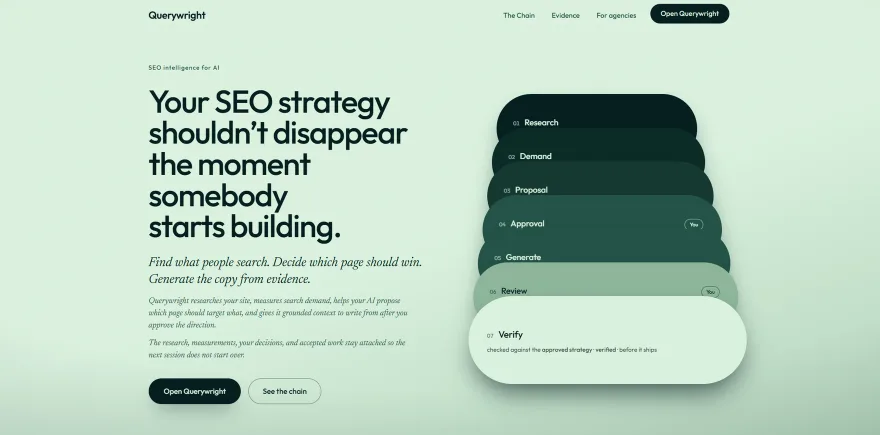
03 / Featured work
Querywright
Founder and sole developer. The app, its MCP server, the marketing site and the layered green system it wears, designed and built solo.
Seven steps, from Research to Verify. The fourth and the sixth belong to a person, so a recommendation can never quietly become a decision.
Behind the front door
Keep the thread
from search to site.
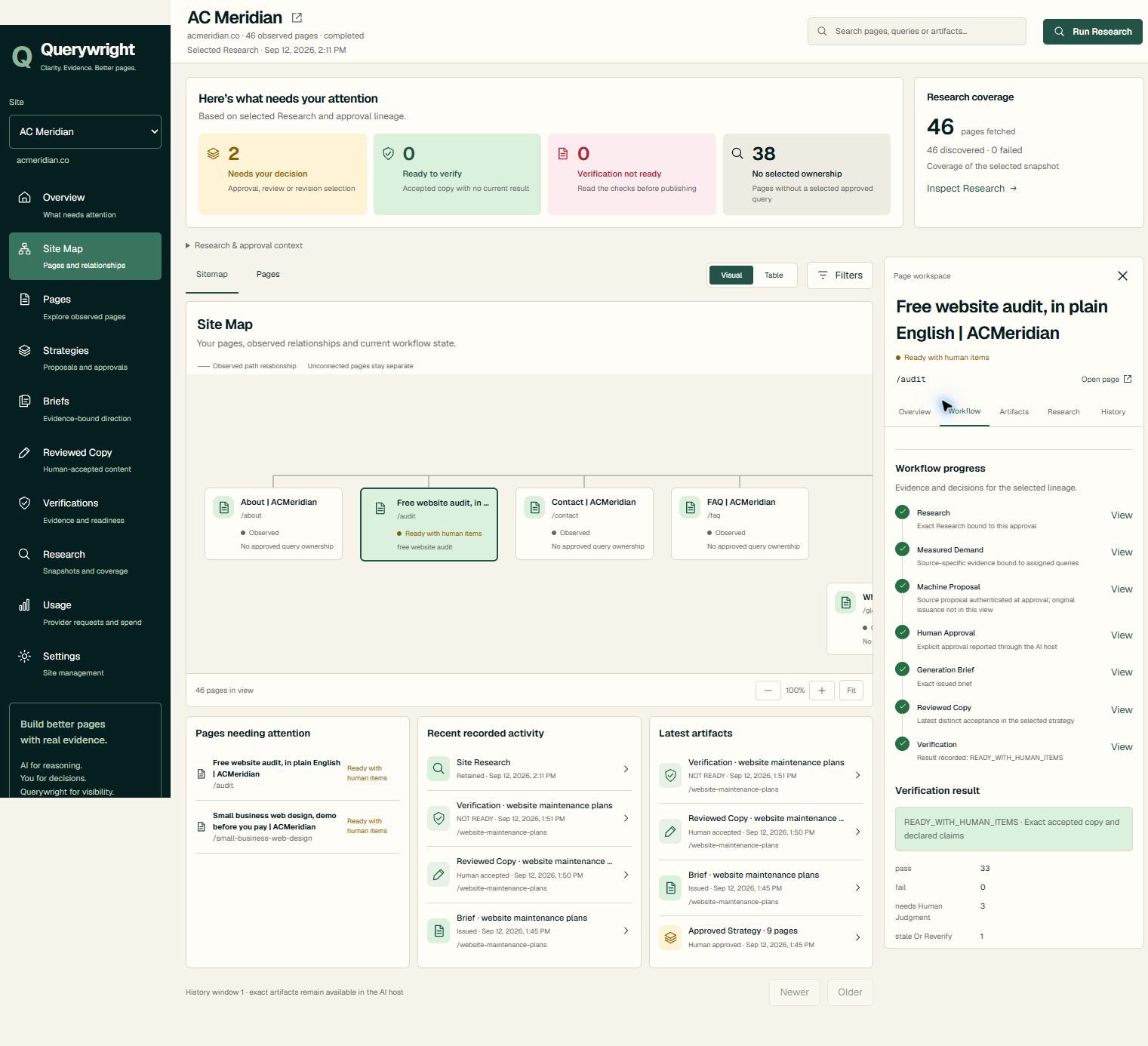
/audit on acmeridian.co, the studio site Querywright was dogfooded on. Captured 12 September 2026. Open the full capture (opens in a new tab)Verification never rounds up.
Before a page ships, Querywright checks the accepted copy against the approved strategy: lineage, structure, the title and H1, the anchor phrases. The result above says exactly that, in those words, instead of turning it into a score. I built it that way on purpose. A recommendation is allowed to stay a recommendation until a person turns it into a decision.
04 / Fonthead
Fonthead: the type becomes the artwork
Fonthead is a type foundry that runs in your browser: it turns an alphabet sheet, or your own handwriting, into a font your computer will actually install. Three faces made with it.
Up to 32 characters, set live in the face you pick.
Now set in Street.
Every glyph traced and spaced, exported as OTF, TTF and WOFF2, then published to a community wall where everything else was made the same way. The tracing, the OpenType build and the WOFF2 compression all run in the tab.
Three finished faces, set as a live specimen. Typing here changes the words, not the fonts: nothing is generated or exported.
Three finished faces, shown as a static specimen.

05 / Duckadrift
A serious tool.
A very unserious duck.
A still from the site’s own water simulation, rendered from its source. On the live site you grab the duck, dunk it, and scroll down into the water.
The site’s own water simulation, running here from its source. Dunk the duck, or pause the water. On the live site you also grab the duck and scroll down into it.
An architecture decision record is a written rubber duck: you explain the decision to it, and the act of explaining is the point.
Duckadrift is the duck that talks back. A GitHub Action, it reads every architecture decision record in a repository, checks whether the code still agrees with what was decided, and fails the pull request when the two drift apart. It never writes an ADR. It only holds you to the ones you wrote.
Built solo, end to end. A TypeScript composite Action wrapping a plain CLI, on the GitHub Marketplace: seven deterministic checks that can fail CI with no network calls, five semantic checks that only interrupt a pull request once a calibration gate opens on measured data, and the calibration gate itself, which stays shut until there is enough measured data to open it.
06 / A&C Meridian
Built for the block.


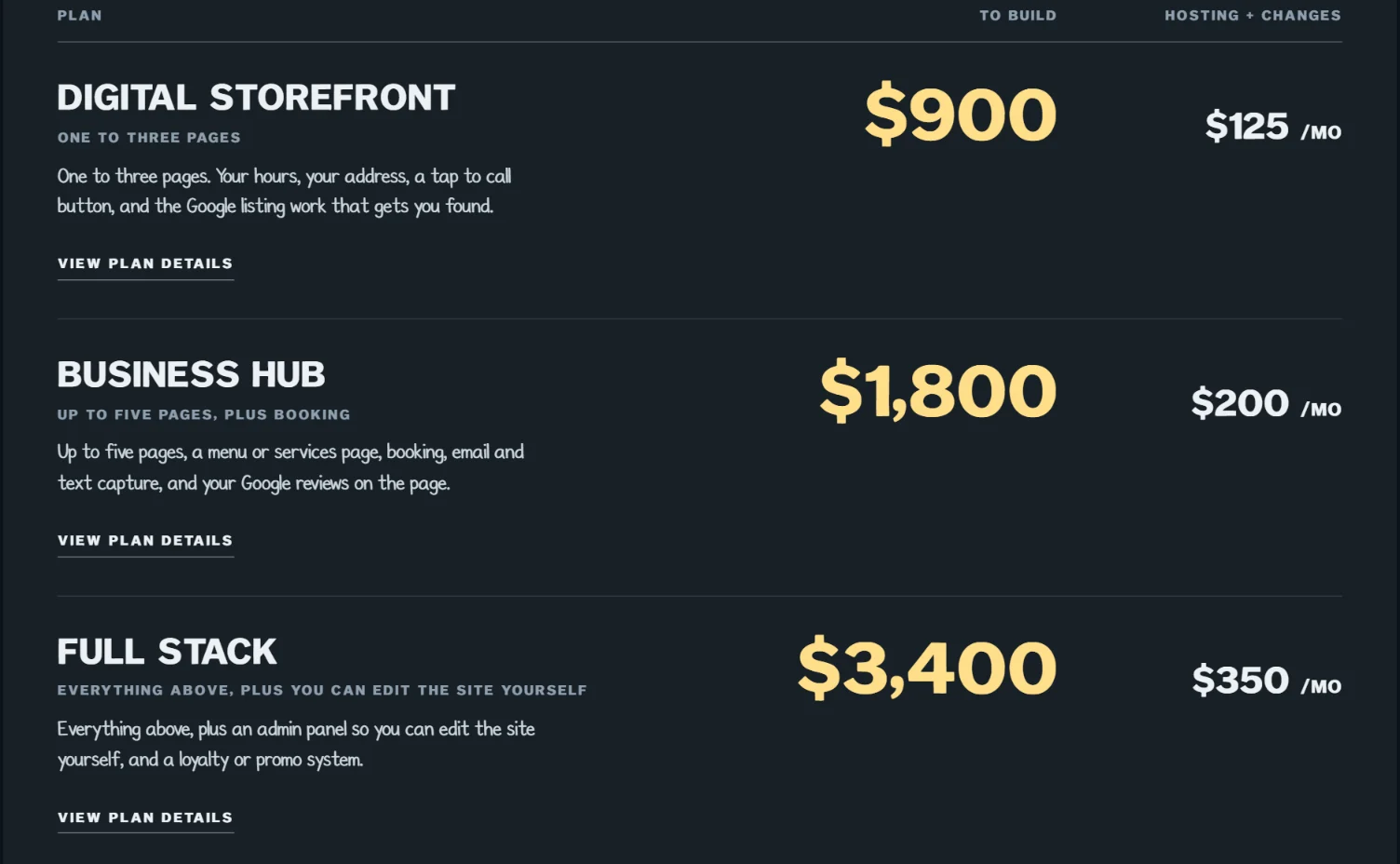

The offer and the price, before the call.
The home page opens with what the studio does, the blocks it works on and the starting price, then one action. A screen further down, the board publishes all three plans with the build price beside the monthly, so they can be read against each other on the page rather than asked for.
Captures from acmeridian.co, 15 September 2026, at 1440px and 390px. The photograph is the site’s own published hero image.
The studio, and Stephen’s part in it
A&C Meridian is the two-person Bronx studio Stephen co-founded with his cousin Michael Cortes, building websites for small businesses from Riverdale to Woodlawn. This is the studio’s own site rather than a client’s: the offer it makes to a shop owner, published under its own name.
Built solo. Forty-four static pages on Astro with no bundled JavaScript, and every price kept in one file that feeds the board, the plan pages and the structured data. The rest is in the case study.
07 / The person behind the work
Stephen Alatriste
I’m Stephen, an independent AI-native creative engineer. I design and build websites, software products, and interactive experiences.
AI is part of how I explore and build. I lead the creative direction, make the decisions, and stay responsible for the finished work.
I’m interested in the part where design and engineering change each other: when a visual idea suggests a useful interaction, or a technical possibility leads somewhere unexpected. I take projects through that process, from an early direction to something people can actually use.
Independent creative practice in Maryland.
Also co-founder of A&C Meridian.
08 / Your turn
Your turn.
Tell me what you’re thinking.
A website, a product, an interactive experience, or an idea that hasn’t quite found its shape.
Thanks. Your message is saved.
Your email address is saved with it, so I can write back.
Or write to me directly